
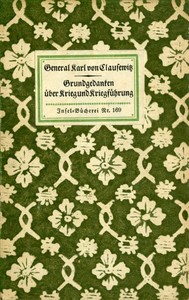
Grundgedanken über Krieg und Kriegführung by Carl von Clausewitz
Let's be clear from the start: this is not a novel. There's no plot in the traditional sense. Carl von Clausewitz's On War is an unfinished, deeply analytical work that tries to build a theory of war from the ground up. Think of it as a massive, interconnected series of essays written by a Prussian officer in the 1830s.
The Story
There's no character to follow or mystery to solve. Instead, Clausewitz asks big questions and builds his answers piece by piece. He starts with a simple, famous definition: War is the continuation of politics by other means. From there, he explores the core elements that make war what it is. He talks about the 'friction' of war—the countless small things that go wrong and derail the best-laid plans. He describes the 'fog of war,' that constant state of uncertainty commanders face. He breaks down the relationship between the government, the military, and the people. A huge part of his argument is the 'trinity' of war: the blind natural force of violence and hatred, the play of chance and probability, and war's subordination to policy. The book is his attempt to create a framework for understanding this incredibly complex human activity.
Why You Should Read It
You should read it because it makes you think. Even if you never lead an army, Clausewitz's ideas are everywhere. You see them in business strategy, in political campaigns, and in how countries interact today. His concept of the 'center of gravity'—the source of an enemy's power—is used by analysts in all kinds of fields. Reading him strips away the Hollywood glamour of war and shows it for what it is: a brutal, uncertain tool. What stuck with me was his humanity. He doesn't see war as a chess game played by geniuses. He sees it as a clash of wills, filled with fear, courage, and luck. He respects the reality of combat, and that gives his writing a raw power.
Final Verdict
This book is not for everyone. It's demanding. But if you're a history nerd, a political science student, a strategy game fanatic, or just someone who wants to understand a fundamental force in human history, this is essential reading. It's the book that every serious student of conflict, from military academies to boardrooms, has grappled with. Don't try to read it all at once. Take it in small chunks, maybe a chapter a week, and let the ideas sink in. It's less of a story and more of a conversation with one of history's sharpest military minds.
This content is free to share and distribute. It is available for public use and education.





Dorothy Lee
4 months agoI have to admit, the content flows smoothly from one chapter to the next. I will read more from this author.