
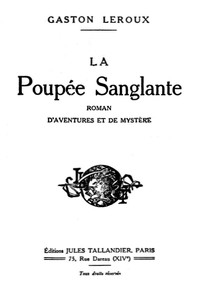
La Poupée Sanglante by Gaston Leroux
Gaston Leroux, the mind behind The Phantom of the Opera, gives us another slice of Parisian gothic with La Poupée Sanglante (The Bloody Doll). Forget cozy mysteries—this one gets under your skin.
The Story
Professor Jacques Cotentin is a pioneer in "artificial life." In his secret lab, he succeeds in creating Christine, a beautiful, sentient woman made from synthetic materials. To the world, she’s his ward. To him, she’s his greatest achievement. When Jacques dies suddenly, Christine is left vulnerable and confused, reliant on his friend and lawyer, Gabriel, for protection.
That’s when the terror starts. A series of brutal murders rocks Paris. The only clue? A tiny, bloody fingerprint at each scene that forensics can’t match to any human—except Christine. The police close in, convinced the doll is a killer. Gabriel is torn between his duty, his growing feelings for Christine, and a horrifying doubt: did her creator build a fatal flaw into her very being? The race is on to find the real killer before Christine is destroyed, or before she proves everyone’s worst fears right.
Why You Should Read It
This isn’t just a "whodunit." It’s a "what-is-it?" The real suspense isn't only about the murders, but about Christine herself. Leroux makes you care for her. She’s naive, she loves music, she yearns for a normal life. But then you get those chilling moments where something seems… off. Is she a victim or a villain? The book plays with that question masterfully.
It also feels surprisingly modern. We’re still obsessed with stories about artificial intelligence and what makes a person real. Christine’s struggle for identity and acceptance, set against a backdrop of fear and prejudice, hits hard. The atmosphere is pure old-Paris atmosphere—foggy streets, grand opera houses, sinister laboratories—making it a perfect, moody escape.
Final Verdict
Perfect for readers who love classic gothic tales with a sci-fi twist. If you enjoyed the tragic romance of Phantom or the existential dread of stories like Frankenstein, this is your next read. It’s also great for mystery fans who want something different from a standard police procedural. Fair warning: it’s a product of its time (originally published in the 1920s), so the pacing is deliberate and the prose is rich. But if you settle into its rhythm, you’ll find a haunting, strange, and utterly compelling story about creation, love, and the monster within—or beside—us.
This digital edition is based on a public domain text. Access is open to everyone around the world.
Brian King
1 year agoI stumbled upon this title and it challenges the reader's perspective in an intellectual way. I couldn't put it down.





Daniel Perez
1 year agoJust what I was looking for.