
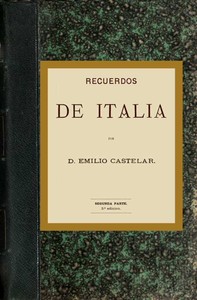
Recuerdos de Italia (parte 2 de 2) by Emilio Castelar
Emilio Castelar's 'Recuerdos de Italia' is a unique blend of travel diary, political commentary, and personal reflection. This second volume completes his journey through a nation in the throes of dramatic change.
The Story
There isn't a traditional plot with a hero and a villain. Instead, Castelar acts as our guide through the Italy of the 1860s and 70s. He continues his travels, moving through the heart of the newly unified kingdom. We see Florence not just as a museum of Renaissance art, but as a temporary capital buzzing with political energy. We visit Rome after it has been wrested from papal control, feeling the weight of its ancient history collide with its new role as a modern capital. Castelar introduces us to the people shaping this new Italy: thinkers, painters, and statesmen. He describes landscapes and ruins, but always connects them to the living, breathing struggle of a people trying to define themselves. The 'story' is the birth of a nation, told through the eyes of a fascinated and eloquent foreigner.
Why You Should Read It
What makes this book special is Castelar's voice. He's not a detached historian; he's fully immersed. His writing is passionate and full of vivid imagery. You can almost smell the dust in the Roman Forum and hear the debates in Florentine cafes. He gets excited about art and architecture, but he's equally gripped by the big ideas of freedom, national identity, and progress. He asks questions that are still relevant today: How does a country honor its past without being trapped by it? Can political unity create a true cultural unity? His insights are sharp because he's comparing everything to his native Spain, which was grappling with similar issues. It's like getting a letter from a brilliantly observant friend who's witnessing history firsthand.
Final Verdict
This book is perfect for readers who think they don't like 19th-century nonfiction. It's not a stuffy academic text. It's for the armchair traveler who loves history, the Italophile curious about the country's roots, and anyone who enjoys smart, personal writing about place and culture. You'll need a little patience for the period style, but the reward is a stunningly clear window into a pivotal moment. It's a reminder that nations aren't built just on maps and treaties, but on art, argument, and collective memory.
This text is dedicated to the public domain. Distribute this work to help spread literacy.
Jackson White
1 year agoGreat read!
Andrew Lopez
1 year agoA bit long but worth it.
Elijah Allen
10 months agoI came across this while browsing and it provides a comprehensive overview perfect for everyone. Highly recommended.




Patricia Brown
9 months agoPerfect.