
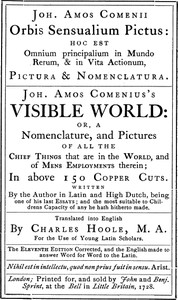
The Orbis Pictus by Johann Amos Comenius
Don't go into The Orbis Pictus looking for a traditional narrative. Think of it instead as the very first visual encyclopedia designed for young minds. Published in 1658 by the Czech teacher and philosopher Johann Amos Comenius, this book was revolutionary. Its full title translates to The Visible World in Pictures, and that's exactly what it delivers. Comenius organized knowledge into 150 short chapters, each pairing a detailed woodcut illustration with simple, parallel Latin and vernacular language text.
The Story
There's no plot, but there is a journey. The book starts with the invocation of God and the spiritual world, then systematically moves through nature: the elements, plants, animals, and the human body. From there, it explores human society—trades, professions, domestic life, and even social structures. Each element is labeled with a number in the picture, corresponding to a numbered term in the text. The 'story' is the unfolding of creation itself, presented as something orderly, knowable, and meant to be studied.
Why You Should Read It
Reading The Orbis Pictus is a deeply human experience. You feel Comenius's passionate belief that education should be for everyone, that learning should be joyful, and that seeing is the first step to understanding. The illustrations are charmingly crude but incredibly detailed, offering a snapshot of 17th-century life and thought. You see what they valued, how they worked, and how they saw their place in the world. It's humbling to realize this was considered a complete introductory education. It’s also surprisingly moving; this was a radical act of hope, a tool meant to shape better, more knowledgeable people.
Final Verdict
This book isn't for someone seeking a thrilling novel. It's perfect for history buffs, educators, graphic designers, or anyone fascinated by the history of ideas and how we learn. It's a quiet, profound look at a foundational moment in publishing and pedagogy. Pick it up for 15 minutes, explore a few chapters on birds or carpentry, and you'll be holding a piece of intellectual history. It’s a reminder that the desire to make sense of our world, and to share that understanding with the next generation, is one of our oldest and best impulses.
This content is free to share and distribute. You are welcome to share this with anyone.
Michelle Ramirez
1 year agoIf you enjoy this genre, the plot twists are genuinely surprising. This story will stay with me.
Liam King
11 months agoAfter finishing this book, the arguments are well-supported by credible references. Definitely a 5-star read.




Kevin Robinson
1 year agoSolid story.