
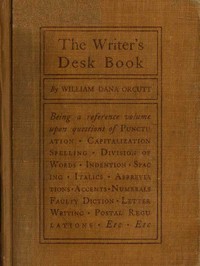
The Writer's Desk Book by William Dana Orcutt
Published in 1912, The Writer's Desk Book isn't a novel or a memoir. Think of it as the ultimate style guide and professional manual for authors of its era. William Dana Orcutt wrote it from his perspective as a printer and publisher, aiming to clear up the common mistakes and uncertainties that plagued submitted manuscripts.
The Story
There's no plot in the traditional sense. Instead, the book is organized as a practical reference. It walks you through the entire physical process of preparing a manuscript for publication, from the proper type of paper and ink to use, to correct formatting, punctuation, and proofreading marks. It gives advice on submitting work, understanding publishing contracts, and even how to handle royalties. A huge chunk of the book is a specialized dictionary covering tricky words, common errors, literary and historical allusions, and proper forms of address. It's a snapshot of the tools a working writer needed at their fingertips before the internet existed.
Why You Should Read It
Reading this today is a delightfully strange experience. It's partly a history lesson. You get a real sense of the formality and precision required in publishing over a century ago. The advice on using a 'type-writer' or mailing a manuscript feels charmingly archaic. But what's really cool is seeing what hasn't changed. The struggles with grammar, the desire for clarity, and the focus on professional presentation are all totally familiar. Orcutt's voice is direct and no-nonsense; he's the expert in the room trying to save everyone time and embarrassment. It makes you appreciate the ease of modern writing tools while giving you a deep respect for the craft as it was practiced then.
Final Verdict
This isn't for everyone. If you're looking for a page-turner, look elsewhere. But if you're a writer, an editor, a history nerd, or just someone fascinated by the everyday details of how creative work gets done in a different time, this book is a treasure. It's perfect for anyone who loves peeking behind the curtain of literary history. You won't find inspirational quotes about the muse here—just solid, practical advice on how to get your work out the door, 1912-style. It's a unique and insightful look at the bedrock of the writing profession.
This historical work is free of copyright protections. Thank you for supporting open literature.
Susan Harris
4 months agoGreat digital experience compared to other versions.
Joshua Garcia
1 year agoJust what I was looking for.
Joshua Anderson
2 years agoI have to admit, the plot twists are genuinely surprising. Truly inspiring.





Donald Taylor
7 months agoFinally a version with clear text and no errors.